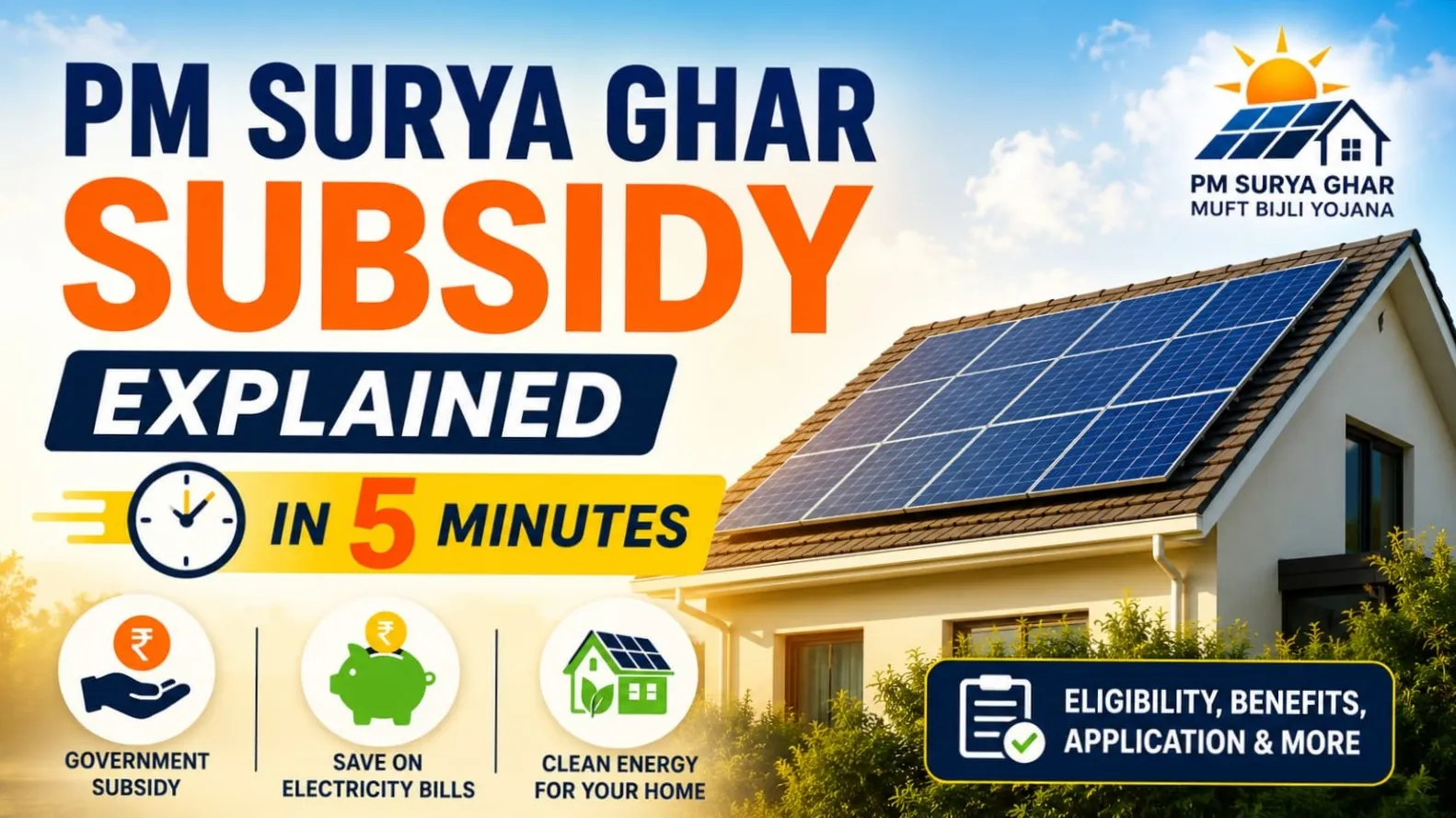
PM Surya Ghar Subsidy Explained in 5 Minutes
A Comprehensive Overview of India's Rooftop Solar Revolution
Introduction
In February 2024, the Government of India launched one of its most ambitious clean energy initiatives — the PM Surya Ghar: Muft Bijli Yojana. Designed to harness the country's abundant solar potential, this flagship scheme aims to install rooftop solar panels on one crore (10 million) residential households by March 2027. The programme represents a decisive shift in India's energy policy, placing renewable energy directly in the hands of ordinary citizens while offering significant financial relief through subsidies and free electricity units.
What is the PM Surya Ghar Scheme?
PM Surya Ghar: Muft Bijli Yojana is a central government scheme under which eligible households can install grid-connected rooftop solar photovoltaic (PV) systems and receive a direct benefit subsidy from the government. The programme is administered by the Ministry of New and Renewable Energy (MNRE) and is implemented through the national portal — pmsuryaghar.gov.in. Beneficiaries are provided with subsidised solar installations, enabling them to generate their own electricity, reduce their utility bills substantially, and contribute to India's net-zero carbon emission goals.
Subsidy Structure and Financial Benefits
The subsidy framework under PM Surya Ghar is tiered based on the capacity of the solar system installed. The central subsidy is provided as a Direct Benefit Transfer (DBT) directly into the beneficiary's bank account upon successful installation and inspection. The applicable subsidy rates are as follows:
For a 1 kW system — ₹30,000 subsidy (covering approximately 30% of the installation cost).
For a 2 kW system — ₹60,000 subsidy, making mid-range installations highly attractive.
For a 3 kW system or above — a flat subsidy of ₹78,000 is provided.
Systems above 3 kW do not receive additional subsidy beyond the ₹78,000 cap.
In addition to the central subsidy, many state governments offer additional incentives, further reducing the net cost to the household. Beneficiaries generating surplus electricity may also sell it back to the grid through net metering, thereby generating an additional source of income.
Eligibility Criteria
To avail the benefits under PM Surya Ghar, applicants must fulfil the following conditions:
The applicant must be an Indian resident and a homeowner with a valid residential electricity connection.
The property must be suitable for rooftop solar installation, with adequate shadow-free area.
The applicant must not have previously availed of any central government solar subsidy.
Installation must be carried out exclusively through empanelled vendors registered on the national portal.
How to Apply
The application process is entirely digital and consumer-friendly. Interested households must visit the official portal at pmsuryaghar.gov.in and register using their electricity bill details and Aadhaar-linked mobile number. Upon successful registration, the applicant selects a government-empanelled vendor, who carries out the site assessment and installation. The subsidy amount is credited directly to the beneficiary's bank account within 30 days of successful commissioning and inspection by the local Distribution Company (DISCOM).
Broader Impact and Policy Significance
PM Surya Ghar is expected to add 30 GW of rooftop solar capacity nationally, reduce CO₂ emissions by an estimated 720 million tonnes annually, and generate approximately 17 lakh direct and indirect employment opportunities in the clean energy sector. For individual households, a 3 kW system typically generates 300–360 units of electricity per month — sufficient to cover the average monthly consumption of a middle-income family and potentially eliminate electricity bills entirely. The scheme is central to India's broader commitment of achieving 500 GW of non-fossil fuel energy capacity by 2030.
Conclusion
PM Surya Ghar: Muft Bijli Yojana is more than a subsidy programme — it is a transformative step towards energy self-reliance, affordability, and environmental sustainability. By converting rooftops into power-generating assets, the Government of India is democratising clean energy access and empowering millions of households to become active participants in the nation's green energy transition. For homeowners seeking long-term savings and energy independence, this scheme represents an unparalleled opportunity that deserves immediate attention and action.
Keywords