
Solar Panels: Powering a Sustainable Future
Solar energy has evolved from a niche technology to one of the fastest-growing power sources on the planet. As climate change accelerates and fossil fuels diminish, solar panels have emerged as one of humanity's most promising tools for building a cleaner, more resilient energy future.
From Scientific Discovery to Global Revolution
The photovoltaic effect was first observed by French physicist Edmond Becquerel in 1839, yet practical solar technology did not emerge until Bell Laboratories developed the first functional silicon solar cell in 1954. For decades, solar power remained prohibitively expensive. However, sustained government investment, research, and economies of manufacturing scale reduced costs by over 99% in four decades — from $76 per watt in 1977 to less than $0.20 per watt today. Solar is now cost-competitive with coal, gas, and nuclear power across most of the world.
How Solar Technology Functions
Solar cells, predominantly manufactured from silicon, convert sunlight into electricity through the photovoltaic process. Photons from sunlight dislodge electrons within the silicon material, generating a direct current (DC) that is subsequently converted to alternating current (AC) via an inverter for household and commercial use. Contemporary panels are available in monocrystalline, polycrystalline, and thin-film configurations, each offering distinct trade-offs between efficiency, durability, and cost. Emerging perovskite cell technologies promise further improvements in both performance and affordability.
Scale of Global Adoption
In 2023, global solar installations surpassed 400 gigawatts of new capacity — sufficient to power hundreds of millions of homes. The International Energy Agency projects solar will become the world’s largest electricity source by 2027. Applications now extend well beyond conventional rooftop installations to include utility-scale desert farms, floating “floatovoltaic” systems on reservoirs, agrivoltaic installations integrating agriculture with energy generation, and solar-embedded building facades. In developing regions, solar is enabling communities to access electricity for the first time without reliance on traditional grid infrastructure.
Challenges and the Path Forward
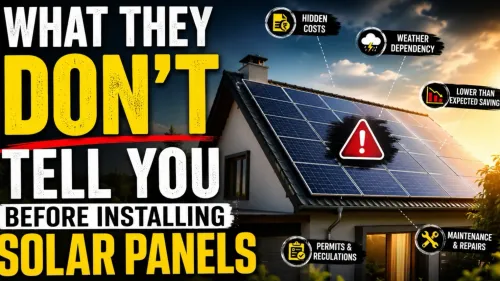
Intermittency remains the most significant technical challenge, as solar generation is dependent on sunlight availability. Battery storage technologies — particularly advancing lithium-ion and solid-state systems — are developing in parallel to address this limitation. Grid modernisation, responsible end-of-life panel recycling, and the environmental footprint of manufacturing also require ongoing attention. These are, however, engineering and policy challenges well within the industry’s capacity to resolve through sustained innovation and international cooperation.
A Transformative Energy Transition
Solar energy represents one of the most consequential transitions in modern industrial history. The collective impact of widespread solar adoption is substantial: panels already displace hundreds of millions of tonnes of CO₂ annually. The sun delivers more energy to Earth in one hour than humanity consumes in an entire year. We are only beginning to harness that potential. The rise of solar panels is ultimately a testament to human ingenuity — and a defining choice in the kind of future we elect to build.
Keywords