SOLAR ENERGY
TOPCon vs Mono PERC vs Bifacial
A field guide to the three panels fighting for your rooftop
Stand on any rooftop being fitted for solar today and you'll hear installers argue like sommeliers over a wine list. One swears by Mono PERC because it's proven. Another pushes TOPCon, calling it the smart upgrade. A third insists bifacial panels are the only ones worth bolting down. They're not wrong, exactly. They're just describing three different bets on how sunlight becomes electricity — and each bet comes with its own trade-offs.
Mono PERC: the reliable workhorse
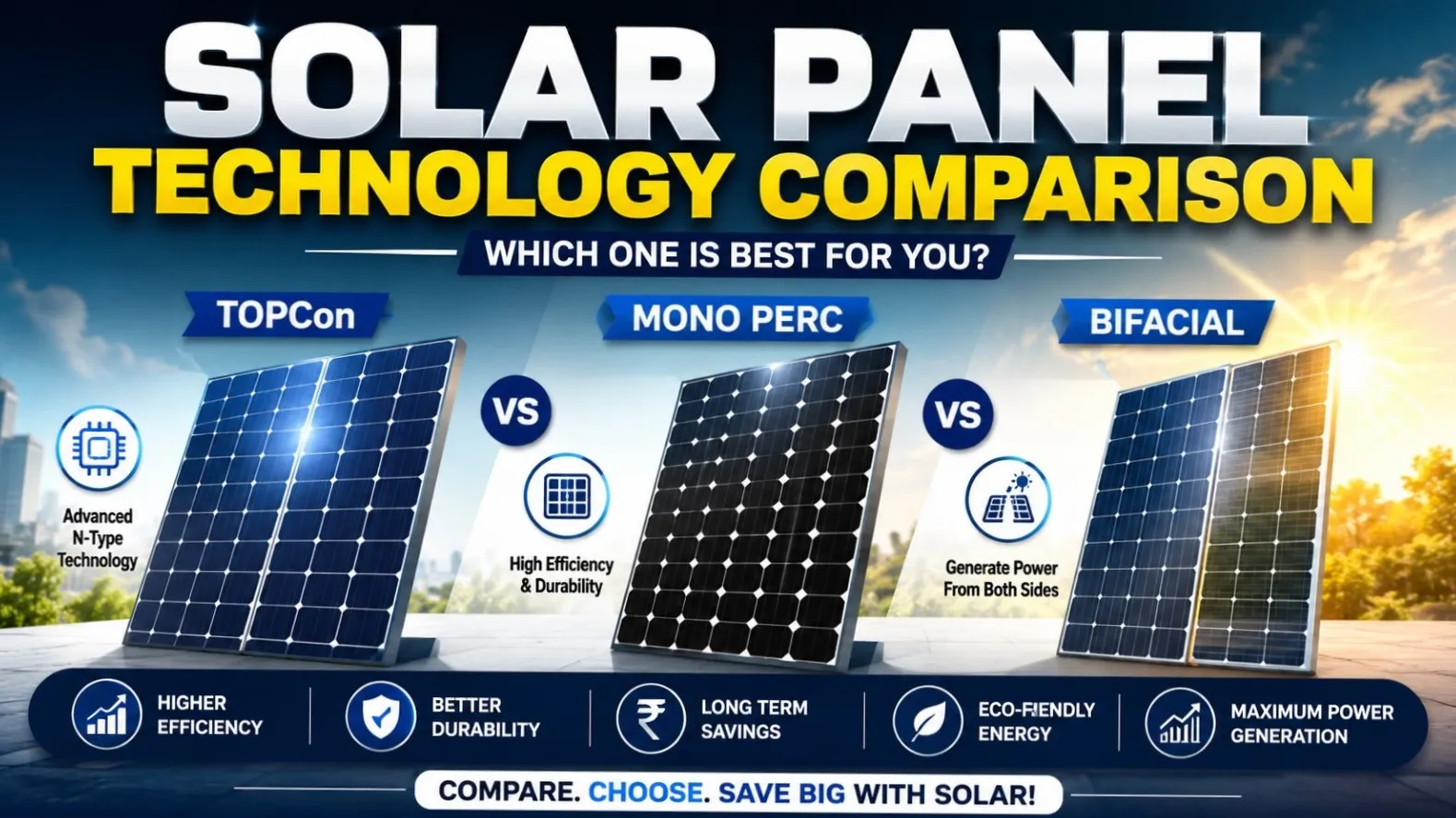
Passivated Emitter and Rear Cell technology is the panel that made solar affordable for the masses. A thin reflective layer on the back of the cell bounces stray light back in for a second chance at capture, nudging efficiency up from the plain monocrystalline cells before it. It's mature, cheap to manufacture, and easy to source almost anywhere. The catch is that it's nearing its physical ceiling — most Mono PERC modules top out around 21 to 22 percent efficiency, and manufacturers have largely stopped investing in pushing it further. Think of it as a dependable sedan: nothing thrilling, but it will get you there.
TOPCon: the quiet overachiever
Tunnel Oxide Passivated Contact cells add an ultra-thin oxide layer beneath the rear contacts, cutting down the electron losses that quietly rob every PERC panel of performance. The result is efficiency in the 23 to 25 percent range, better heat tolerance, and slower degradation over the decades a panel sits in the sun. TOPCon has become the new default for manufacturers scaling up production, which means prices are falling fast even as performance climbs. It's less flashy than bifacial glass, but for most homes it's quietly become the smartest single upgrade in the market.
Bifacial: sunlight from both sides
Bifacial panels drop the opaque backsheet entirely, using glass on both faces so the rear side can harvest light reflected off rooftops, sand, snow, or white gravel. On the right surface, that can mean a 5 to 20 percent energy bonus over an identical single-sided panel. But that bonus is conditional — a bifacial panel mounted flush against a dark shingle roof barely outperforms its one-sided sibling, because there's nothing behind it to reflect light back up. Bifacial earns its keep on elevated racking, carports, ground mounts, and commercial rooftops with light-colored surfaces, not on every suburban roof.
The honest answer: TOPCon is fast becoming the sensible default, Mono PERC still makes sense on a tight budget, and bifacial only pays off when the ground beneath it is doing some of the work.
So which one belongs on your roof? It depends less on marketing brochures and more on geometry and budget. A shaded, dark-tiled residential roof gains almost nothing from bifacial glass, and TOPCon's efficiency edge will matter more over 25 years than PERC's lower sticker price. A ground-mounted array over reflective gravel, or a solar carport with open sky underneath, is exactly where bifacial modules turn a marketing gimmick into real kilowatt-hours. There's no single winner here — just three technologies, each waiting for the right roof, and the right question, to prove its worth.
Keywords